
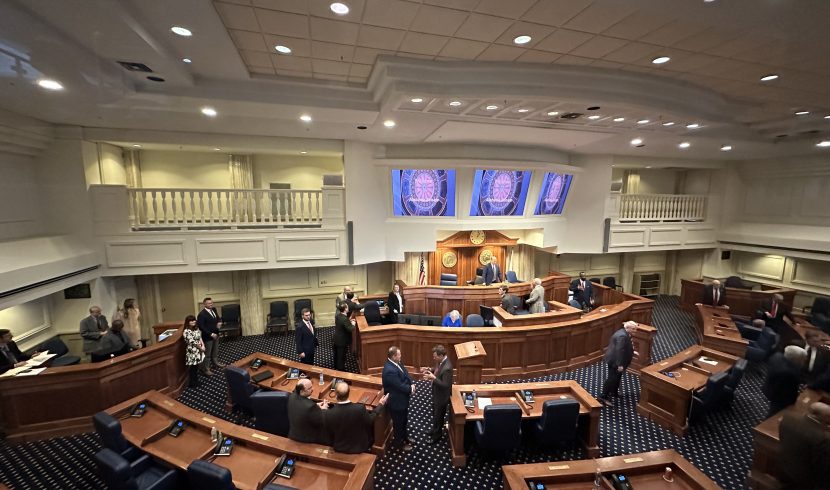
An expanded Alabama Public Service Commission could hold formal rate hearings with the utility companies it regulates, but would not be required to under legislation approved Wednesday by the Alabama Legislature.
Senate and House leadership praised the passage of the Power to the People Act, now sent to Gov. Kay Ivey’s desk, but the bill’s original GOP sponsor, and several House members, voted against it Wednesday afternoon.
“The Alabama House and Senate stood united to reform how utilities are regulated and demand an unprecedented amount of accountability for consumers across the state,” Speaker Nathaniel Ledbetter and Senate President Pro Tem Garlan Gudger, said in a joint statement. “In addition to outlawing rate increases for the next three years while still allowing rate reductions at any time, the Power to the People Act shines a bright, public spotlight on how rates are set.”
The new version of House Bill 475, substituted in Senate committee Tuesday, looks a lot like Sen. Clyde Chambliss’ Senate Bill 360, approved by the Senate two weeks ago. But the new bill says that five of the seven elected members could vote to hold rate hearings. Alternatively, the state energy secretary, a new post created in the bill and appointed by the governor, could call for hearings.
The bill expands the current elected PSC from three members to seven, based on congressional districts. Ivey in July will appoint four commissioners to serve initial terms beginning Jan. 18, 2027. Two will serve two-year terms and two will serve four-year terms. Commission elections are staggered and by 2032, all members will be elected.
The appointed energy secretary will “direct the activities of the commission and shall set the agendas for all meetings of the commissioners.” Commissioners can amend the agenda if at least five of the seven vote to do so.
The bill prohibits rate increases, between October. 1, 2026 until Jan. 1, 2029. And prohibits utility companies from donating to PSC members’ election campaigns.
And, it says that each year the PSC will “convene at least one public meeting per calendar year with utility representatives to provide information to the public on cost trends, reliability, … other regulatory issues the Secretary of Energy deems relevant.”
But formal rate hearings to examine specific issues and to “provide greater transparency and direction to the establishment of base retail rates, with testimony provided under oath,” would need five commissioners or the secretary’s approval.
Sen. Roger Smitherman, D-Birmingham, successfully amended the bill on the Senate floor to give the minority party leaders in the Legislature a say in some of the nominees sent to the governor.
The bill quickly passed the Senate on a 32-0 vote and with little discussion.
It then went back to the House, where Rep. Mack Butler’s original version had passed last month. Butler’s original bill required rate hearings every three years. After it was substituted in a Senate committee Tuesday, Butler said it lacked the “hammer” he wanted.
On Wednesday afternoon, after the Senate unanimously approved the new version of the bill, Butler asked his House colleagues not to agree with the Senate changes and instead go to a conference committee with Senate members to continue discussions. In a rare move, the House voted against the bill sponsor. It went on to approve the new bill and send it to Gov. Kay Ivey for her signature.
Butler later told reporters it felt surreal to vote against a bill that lists him as the sponsor.
Revamping the PSC wasn’t a priority issue entering the legislative session in mid-January, but it became one when a three-bill package was introduced in the House in mid-February and lawmakers began talking about the need to reduce Alabamians’ higher-than-regional-average power bills.
“Moving forward, the expanded commission will have the authority to call formal rate hearings and evaluate Alabama’s rates against national and regional averages, which represents a major step toward greater transparency, accountability, and long-term savings for ratepayers across the state,” Ledbetter, R-Rainsville, and Gudger, R-Cullman, said.
Butler said utility rates are an economic recruitment tool and regular rate hearings can keep them lower. The PSC hasn’t held a rate hearing since the early 1980s.
“We need to be the most competitive in the region, not the highest in the region,” he said.
Asked if the legislation will help Alabamians, Butler said it’s possible.
“I just need the commission to do their job, and hopefully they will,” he said.
The original House bill also included more oversight of solar and wind facilities. That was removed from the Senate-passed version.