
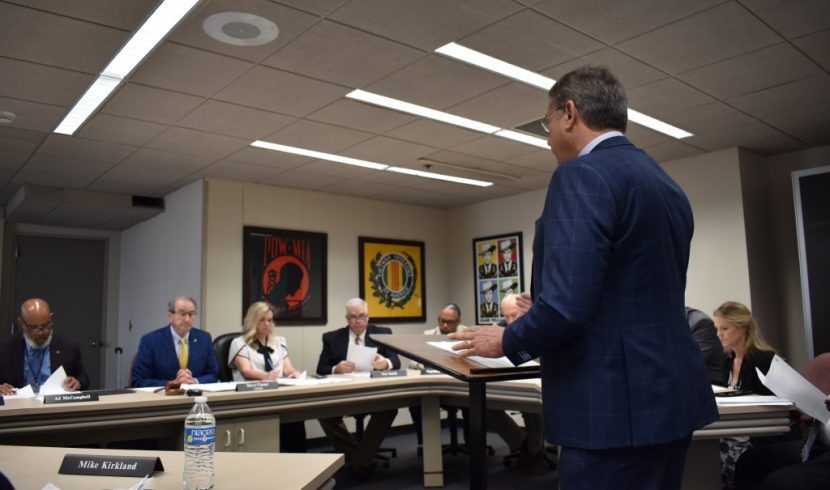
A bill to overhaul the Alabama Public Service Commission received its first committee vote Wednesday with bipartisan support.
The bill, introduced Tuesday, could be on the Senate floor today.
Senate Bill 360 would expand the current three-member Alabama Public Service Commission to seven members elected from the state’s congressional districts. It also creates a secretary of energy position, a governor appointee, to oversee the administration of the commission.
Sen. Clyde Chambliss, R-Prattville is the bill sponsor and his 34 Senate colleagues co-sponsored it. The bill is the chamber’s response to concerns about high energy rates in the state.
Chambliss told the Senate Fiscal Responsibility and Economic Development Committee that in 2000, only two southern states had lower energy rates than Alabama. Now, only one state has a higher rate.
“In 2000, we were at 82% of the national average, now we’re at 92% of the national average,” Chambliss said. “We’re headed in the wrong direction.”
That, he said, has cost Alabamians hundreds of millions of dollars, if not more, over the last 20-some years.
The bill prohibits utility rate increases from Oct. 1, 2026 through June 1, 2029. It also bans utilities from donating to PSC candidates’ campaigns.
During a public hearing, John Dodd of Energy Alabama said that the organization has worked in good faith to offer suggestions for energy cost reduction, including mandatory rate cases, profit reduction measures and keeping appointments out of the regulatory process.
“Instead, this bill does not take the steps needed to reduce Alabama Power’s power bills,” Dodd said.
Alabama Power is the largest utility provider in the state.
“(Senate Bill 360) hands a governor-appointed secretary of energy, who is unaccountable to any voters, the authority to set every PSC meeting and agenda and control commission personnel,” Dodd said. “The PSC, which is the body that is supposed to regulate Alabama Power and other utilities, would now answer most entirely to the governor’s office.”
Chambliss said the seven-member board could override the secretary with the support of five members.
Dodd also opposed wording in the bill that lets the governor immediately appoint the four new board members to initial terms, as opposed to phased-in elections.
A fiscal note on the bill said the additional PSC members and needed staff would increase costs by about $2 million per year.
And the rate freeze could reduce future utility tax receipts deposited into the Education Trust Fund by an undetermined amount, the note says.
The Senate proposal comes after a House leadership-backed energy package stalled last month over concerns about a bill to make the PSC an appointed board. The bill lacked Senate support.
Rep. Mack Butler, R-Rainbow City, has also since filed a bill to change how the PSC operates.
Butler’s House Bill 475 takes several elements from the original bill by Rep. Chip Brown, R-Hollinger’s Island, including requirements about hearings and guarantees that utility companies cannot pass on lobbying expenses to ratepayers.
Butler’s bill also passed out of committee on Wednesday. It now awaits a vote on the House floor.
Butler said he was inspired to introduce the bill after “outrage” from his constituents over a leaked phone call between lobbyists from Alabama Power and Energy Alabama. He said he’s heard from constituents who are deciding between paying their electric bills and other necessities like medicine.
“I heard from them loud and clear, it is time something is done,” Butler said. “Ronald Reagan was president last time that they had a formal rate case hearing.”
The PSC would also have to hold formal rate hearings every three years under the bill. Those rate cases would be conducted as an evidentiary hearing, and all parties involved would testify under oath. The commission would also have the power to subpoena utility companies in order for them to justify their rates.
Members of the PSC could be impeached if they fail to hold or attend the rate hearings required in the legislation.
Butler said he believes rate hearings would likely lower Alabamians’ power bills.
“All the cards would be laid on the table, and the utility is going to have to go under oath during this, which is going to be huge,” Butler said at a committee meeting last week. “If they can justify their record profits, so be it. But the people of at least my district, and I feel certain the entire state, want those cards laid on the table. There’s something clearly wrong when we’re the highest in the region, third highest in the nation, and about 40% higher than TVA.”
The bill also adds a restriction on utility companies’ profits. It prohibits utilities that provide electricity to consumers from incorporating a return on equity higher than the regional average.