
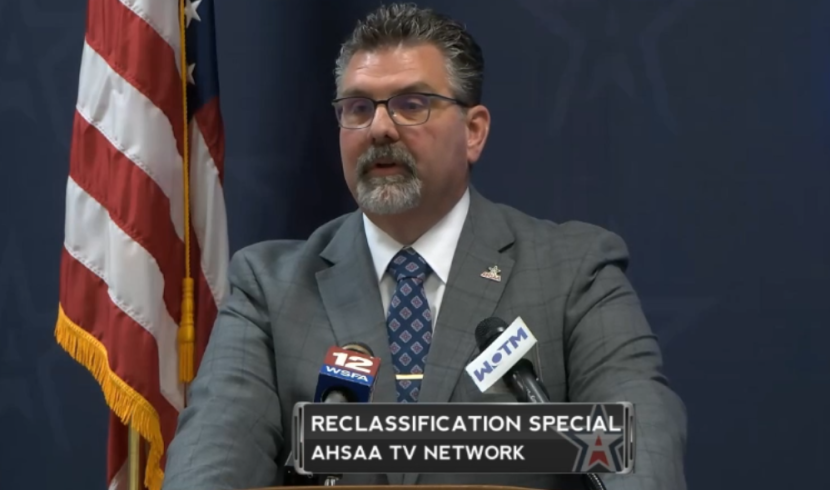
BIRMINGHAM, Ala. – A controversy over how Alabama’s education savings accounts affect athletic eligibility appears to have been settled after the Alabama High School Athletic Association announced that financial aid, including CHOOSE Act vouchers, won’t affect when students can play.
“Funds from the Choose Act, Accountability Act, tuition assistance, teacher reductions, and scholarships will no longer impact athletic eligibility,” AHSAA Executive Director Heath Harmon said in a news release Friday morning.
How that change will affect a lawsuit filed by Gov. Kay Ivey and House Speaker Nathaniel Ledbetter remains unclear. The lawsuit, filed in September, challenged the AHSAA’s earlier determination that CHOOSE Act funding should be treated as financial aid, making high school athletes ineligible to play sports for a one-year period.
A request seeking comment from Ivey was not immediately returned.
A judge in November ordered the parties into mediation. There have been no new court filings since that order.
In her State of the State Address, Ivey said she would support a proposed “Let the Kids Play Act,” though as of Friday morning, no bill with that title had been filed.
The eligibility change was one of several changes approved by the AHSAA’s Central Board of Control.
Beginning with the 2026-27 school year, public and private schools are now separated into different classifications and will compete separately in postseason play, Harmon announced at a press conference prior to the news release.
“The Central Board has approved a championship model that applies only to postseason play,” Harmon said. “Its purpose is to expand opportunity and strengthen the overall championship experience for student athletes across Alabama. All Championships will be played together, both public and private at our championship venues.”
Public and private schools can continue to play each other during the regular season, he said.
Harmon rejected the idea that the move was a separation between public and private schools.
“This is not a separation,” he said. “This is the restructuring of championship pathways so it impacts who plays who in the playoffs. It does not impact anything else. What this does is provide expanded opportunities for championships, not separation.”
Under the new structure, public high schools will be classified into six classifications, down from seven. Private schools will be placed into one of two classifications, designated “A” and “AA.”
A list showing the classification of schools is linked here.
The AHSAA will also eliminate two mechanisms used to address competitive balance. Private schools will no longer have their enrollment multiplied by 1.35 for classification purposes, and the AHSAA will no longer apply a competitive balance factor that could move highly successful teams into higher classifications.
Harmon said the new rules will be in place for two years.
“We believe this is a strong, solid plan, but as with every classification cycle, we will listen to our membership and make adjustments as needed,” he said.
The AHSAA reclassifies schools every two years based on enrollment. The 15-member Central Board is made up of representatives from the AHSAA’s eight districts plus at-large members and a representative from the state department of education. Harmon became Executive Director in July 2024.
The biennial reclassification is typically announced in December, but the court battle over the CHOOSE Act and athletic eligibility appeared to delay the process.
Private schools in Alabama are not required to participate in the AHSAA and may instead join the Alabama Independent School Association, which operates its own championships and classification system.
Lawmakers have periodically challenged the AHSAA’s governance and rules, including during the current legislative session.
Sen. Donnie Chesteen, R-Geneva, chairman of the Senate Education Policy Committee, filed Senate Bill 73 this session. The bill would restrict public schools to participating only in athletic associations whose governing boards are at least 50% appointed by elected officials, including the governor and legislative leaders.
Alabama Daily News could not reach Chesteen for immediate comment Friday.
Chesteen previously told AL.com that he was “tapping the brakes” on the bill after what he described as productive conversations with AHSAA leadership, adding that he believed the Central Board could address lawmakers’ concerns without legislative intervention.