
Before the Legislative Sunset Committee questions this morning representatives of the state occupational licensing boards and other agencies it authorizes, it will have a new requirement.
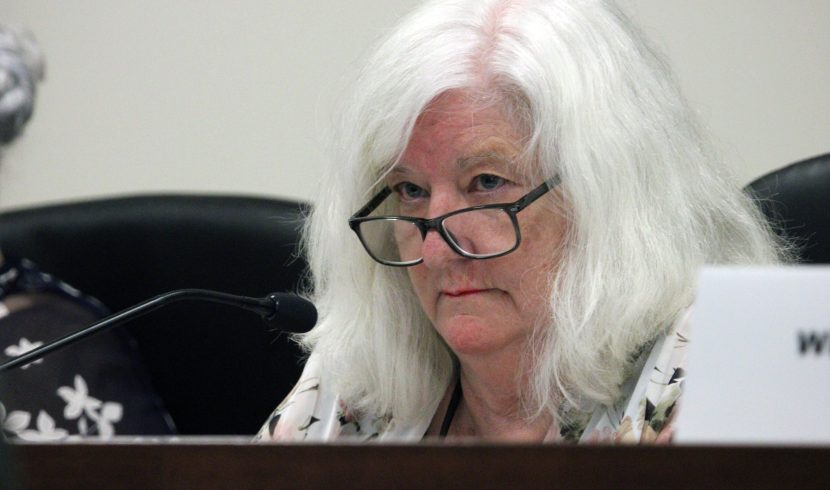
People answering questions about licensure boards’ spending, revenue or their fees on licensees will be sworn in and asked to tell “the truth, the whole truth and nothing but the truth,” committee co-chair Rep. Margie Wilcox, R-Mobile, said Wednesday.
“We’re going to start holding people accountable for untruthful comments or rhetoric or just flat-out fibs and lies,” Wilcox said during the committee’s work session that previewed today’s meeting. She’ll bring a Bible on which people can make the pledge.
Until about two years ago, the sunset meetings were non-events in the State House, largely a rubber-stamping of reauthorizations. In 2023, the committee began taking a closer look at the dozens of agencies that collect annual fees, some totaling hundreds of thousands of dollars per year, from Alabamians who are required by state law to hold an occupational license, ranging from bail bondsmen to pharmacists.
Some meetings and interactions have become contentious, leading to legislative changes in how certain boards, including the one that licenses pharmacies and pharmacists, operate.
The sunset committee on Wednesday kicked off a new round of reviews for reauthorization in 2026. The panel today will get to ask questions of about a half-dozen boards or, in some cases, the third-party contractors hired to manage them.
Based on work session discussions, some boards should expect to be asked why their functions shouldn’t be folded into other state agencies.
For example, the Alabama Construction Recruitment Institute is funded through a fee on the wages of those in the construction industry. The institute’s goal is to educate the public on job opportunities and training in construction. It has six employees and spent about $1.7 million on the effort in fiscal year 2023.
“I want to hear an explanation why this shouldn’t be rolled into the (Alabama) Department of Workforce,” committee member Sen. Sam Givhan, R-Huntsville, said.
Similarly, Wilcox said she wants to know why Alabama is in the minority of states that regulate prosthetic and orthotic care through the Alabama State Board of Prosthetists and Orthotists.
And lawmakers want to know why the almost 30-year-old Alabama Sickle Cell Oversight and Regulatory Commission, funded through the state’s Education Trust Fund and managed by third-party company Smith Warren Management Services, isn’t part of the Alabama Department of Public Health.
“They’re not doing well financially and don’t feel like they’re getting their resources,” Wilcox said.
The sunset committee has a new co-chair and some new members. Sen. Keith Kelley, R-Anniston, joins Wilcox in leading the body. And Sen. Chris Elliott, R-Josephine, is a new member. Elliott for the past three sessions has sponsored bills to combine the oversight and management of many of the dozens of occupational boards under one umbrella state office. He will re-file the bill next year, he’s told ADN.
The committee gets much of its information from the Alabama Department of Examiners of Public Accounts, which regularly audits state agencies.
Audits for the boards on today’s sunset agenda were released Wednesday and discussed at a committee work session. Board representatives will be able to respond to questions and concerns at today’s meeting.
After Wednesday’s meeting, Claire Austin of the Austin Group, which manages the Alabama Board of Home Medical Equipment for about $83,000 per year, said she’s looking forward to discussing the recent audit.
That board regulates businesses that sell at-home medical devices. The audit found several issues, including multiple vacancies on the board and its paying separately for services that should have been included in its contract with the Austin Group.
Austin has managed this board since 2020 when she won the contract previously held by Warren Management. She said the vacancy issues are being resolved and part of the problem has been waiting for executive branch appointments, which are out of her control.
As for what at least one lawmaker called a double-billing situation, Austin said that too has been resolved and the money, about $6,600, paid back. She said the board is saving money by paying a contracted inspector in north Alabama, now capped at $4,000 per year rather than paying mileage for an inspector from Montgomery to travel north whenever an inspection is needed.
“There was no double-dipping, no intent to do that,” Austin said.
Will Parker, the Austin Group chief financial officer, said consolidating the management of home medical equipment board under another organization would not save money. State salaries and benefits for the needed staff would cost more than what Austin Group changes, he said.
“At the end of the day, we’re running state government efficiently, like it should be run,” Parker said.