
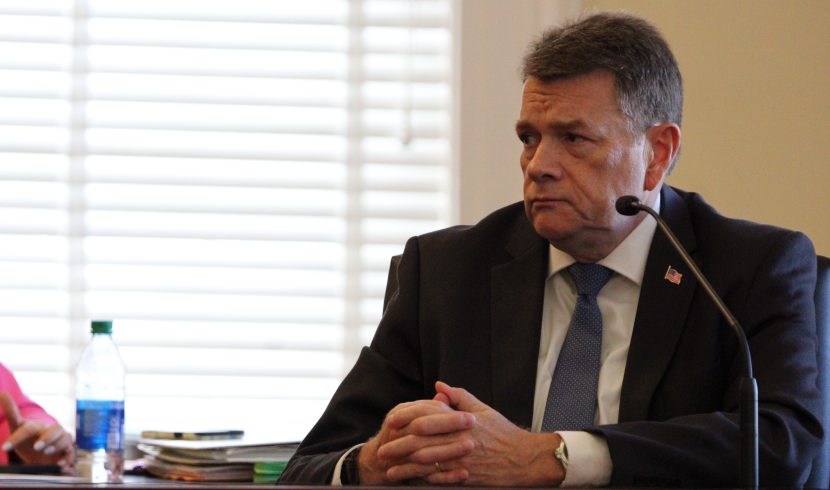
MONTGOMERY, Ala. — Kent Davis, who led the Alabama Department of Veterans Affairs as its commissioner until being removed last year by Gov. Kay Ivey, has filed a federal lawsuit against the governor, claiming his termination amounted to violations of his constitutional rights.
“Ivey’s conduct in terminating Davis was contrary to law and beyond any discretionary authority vested in her as governor and violated Davis’ clearly established rights afforded to him by the United States Constitution and Alabama law,” the lawsuit reads, filed in federal court on Wednesday.
The lawsuit, filed against Ivey in both her official and personal capacities, claims that Davis’ termination constituted a violation of his constitutional rights under the First and Fourteenth amendments, as well as state ethics law pertaining to whistleblowers. The relief sought as outlined in the lawsuit includes either reinstatement or front pay, back pay, and both punitive and “mental anguish” damages.
Ivey spokesperson Gina Maiola indicated that the governor was not concerned about the lawsuit.
“We are extremely confident that Gov. Ivey’s necessary actions will stand any court test there may be,” Maiola told ADN Wednesday.
Filed on behalf of Davis by Kenneth Mendelsohn, attorney with Jemison & Mendelsohn in Montgomery, the suit also alleges Ivey had no authority to terminate him, and that in doing so demonstrated conduct that was “malicious, fraudulent” and “in bad faith and beyond her authority.”
Ivey had first called for Davis’ resignation after an ethics complaint the commissioner filed against Kim Boswell, commissioner of the Alabama Department of Mental Health, was made public. The ADMH commissioner is appointed by the governor and is a member of their cabinet, whereas the ADVA commissioner was instead elected by members of the ADVA State Board.
In her call for Davis’ resignation, however, Ivey did not mention the ethics complaint, and instead alleged that under his leadership, the ADVA had “mishandled” federal grant money from the American Rescue Plan Act. Davis denied the allegation, but eventually reached an agreement with Ivey to step down by the end of 2024.
The ADVA State Board would, however, go on to rebuke Ivey in publicly exonerating Davis of any wrongdoing, as well as officially asking that he rescind his resignation. Ivey would go on to accuse Davis of breaking their agreement – something Davis also denies – by failing to publicly push back against the board’s exoneration of him, and removed him from office last October.
Ivey cited her office’s “supreme executive power of the state” when she dismissed Davis.
“We think it is pretty clear that she did not have the authority to fire him, he did not work for the pleasure of the governor and she did not hire him,” Mendelsohn said Wednesday at a press conference at his Montgomery office. “The law is pretty clear that he was hired by the state board of veterans affairs and could only be terminated by the state board of veterans affairs.”
Mendelsohn represented former Alabama Law Enforcement Agency Secretary Spencer Collier in his 2016 lawsuit against then Gov. Robert Bentley following Bentley’s dismissal of Collier. Collier accused Bentley of having an affair with advisor Rebekah Mason and using state resources to hide evidence of it.
Law change
Ivey this year backed legislation, and got enough GOP support, to make the VA commissioner a cabinet position, selected by her.
Some veterans opposed the legislation, particularly those in South Alabama. But enough veterans groups like the American Legion and Veterans of Foreign Wars supported it, leading to its passage in the 140-member House on a 56-39 vote in March. Ivey signed the bill into law that month and appointed retired Brig. Gen. Jeffrey Newton the new commissioner.
Alabama Daily News’ Mary Sell contributed to this report.